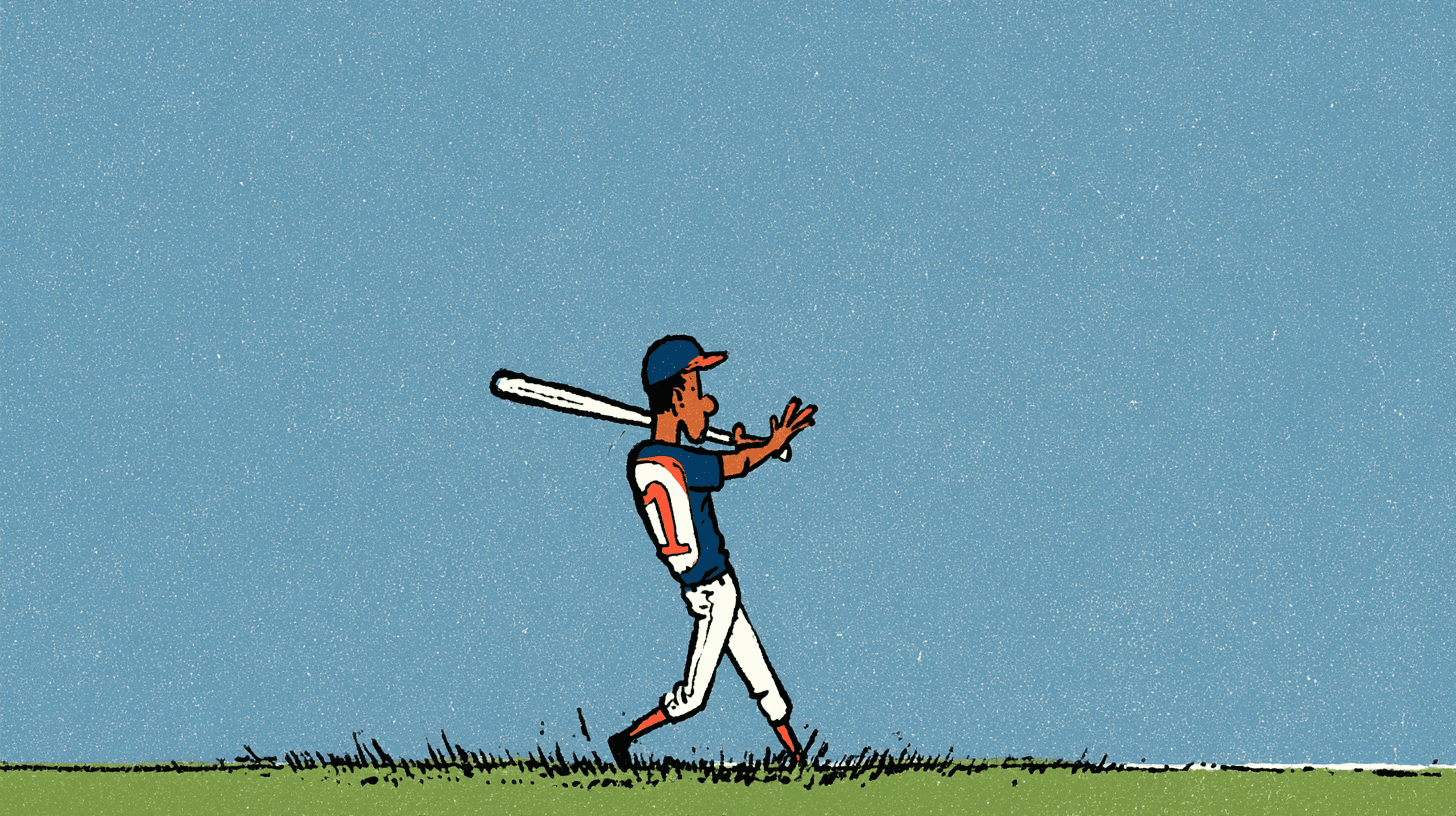
Ask me who baseball's greatest player is and I'll give you the same answer I gave when I was nine, holding a cardboard rectangle with a man in a Giants cap running away from the plate. Willie Mays. Not Ruth, not Bonds, not the guy currently doing things nobody's done in a century. Mays. And I'll tell you why, honestly, with the counterpoint included, because a take you have to protect from evidence isn't a take. It's a mood.
August does this to me. The pennant races tighten, the rotations get thin, somebody's fourth outfielder makes a catch he has no business making, and the dugout argument starts up again like it never stopped. Greatest ever. It's the only debate in sports where the answer keeps changing while the players stay dead still.
Who is baseball's greatest player of all time?
Here's my standard: greatness in this sport is the whole game. Hit, hit for power, run, field, throw. Five things, and the honest truth is almost every immortal is elite at three of them and merely good at the rest. Mays was at the ceiling of all five, for two decades, in center field, which is the hardest place on the diamond to be great for a long time.
660 home runs. More than 3,200 hits. Over 300 stolen bases in an era that had mostly stopped bothering to run. Twenty-four All-Star selections. Twelve Gold Gloves, and the award didn't even exist for his first several seasons. Rookie of the Year in 1951, MVPs in 1954 and 1965, eleven years apart, which is its own kind of argument.
Then the part that makes me lean forward. He was drafted into the Army in 1952 and lost the rest of that season and all of 1953, ages 21 and 22. Those are the years a player like that turns into a monster. Nobody gets to count them. He came back and hit 41 homers with a batting title and won the World Series, and we all just went along with it.
checked the almanac: september 29, 1954, game one at the polo grounds, vic wertz hits it 450 feet to dead center and mays runs it down with his back to the plate and then, the part everybody forgets, whirls and throws it back in so the runner can't advance. the catch is the poster. the throw is the player.
Ruth, Bonds, Gibson: the numbers that complicate it
I'm not going to pretend the leaderboard is on my side. It isn't.
| Player | HR | AVG | SLG | OPS |
|---|---|---|---|---|
| Josh Gibson | short official ledger | .372 | .718 | 1.177 |
| Babe Ruth | 714 | .342 | .690 | 1.164 |
| Barry Bonds | 762 | .298 | .607 | 1.051 |
| Willie Mays | 660 | .301 | .557 | .941 |
Mays is fourth on his own list. Mind the gap like it owes you money, because that gap is real and I'm not hiding it.
The honest counterpoint
Ruth. That's the counterpoint, and it's a good one. He won an ERA title, won more than twenty games twice, and threw 29 2/3 consecutive scoreless World Series innings, a record that stood until Whitey Ford broke it in 1961. Then he stopped pitching and out-slugged entire teams. He didn't dominate the sport, he redesigned it. If your standard is impact on the game itself, the argument ends at Ruth and everybody else is filling out the ballot.
And there's Josh Gibson, whose numbers entered the official record in 2024 and immediately went to the top of the career average, slugging, and OPS leaderboards. Baseball spent a hundred years telling us the ledger was complete. It wasn't. That's a lesson, not a footnote.
What I'm watching
Whether the two-way thing holds. Ohtani has already won unanimous MVPs in both leagues and posted a 50-homer, 50-steal season in 2024, and every inning he throws pulls the Ruth comparison further out of the museum and into the present tense. Also whether the record books keep getting corrected, because they should.
I'll still say Mays. Not because the math commands it, but because the whole game lived in one man for twenty years, and he lost two of the best of them to the Army and never once made it our problem. For the love of the game, that's my ballot.